

Refrigeration and Air Conditioning Technology PDF
If you’ve ever wondered how your refrigerator magically keeps things cold or how your air conditioner manages to cool an entire room in minutes, you’re not alone. I used to be fascinated by these systems, especially when I realized how much science goes into something as simple as the cool air flowing from a vent. That curiosity is one of the many reasons why so many students and technicians search for a refrigeration and air conditioning technology PDF, because having a complete, reliable, easy-to-understand resource makes learning far easier.
When I first downloaded my own HVAC PDF years ago, I had no idea what half the diagrams meant. I remember staring at a refrigeration cycle diagram thinking, “Why does this look like a map from a video game?” But as I dug deeper, things actually started to make sense. What helped the most was having clear explanations, labeled diagrams, and step-by-step concepts. That’s exactly what a good PDF should offer.
In this full-length guide, I’ll walk you through everything you need to know before downloading or using a refrigeration and air conditioning technology PDF. You’ll understand what topics it covers, why it’s useful, how to study from it, who should use it, and even what mistakes to avoid. Think of this as your complete companion, a simplified yet deeply detailed breakdown of the concepts that make cooling technology work.
By the time you finish reading, you’ll not only know what kind of PDF to download but also how refrigeration and AC systems function on a practical level. So, let’s dive in and build a solid foundation before you jump into the PDF world.

What Is a Refrigeration and Air Conditioning Technology PDF?
A refrigeration and air conditioning technology PDF is a digital textbook or training manual that explains the science, components, installation methods, maintenance procedures, and troubleshooting techniques used in cooling systems. These PDFs usually come from:
- Technical institutes
- HVAC training centers
- Engineering colleges
- Skilled-trade programs
- Experienced technicians who create field manuals
The goal is simple: provide a complete, portable source of knowledge so anyone, from a beginner to a professional, can learn refrigeration and AC system step-by-step.
Most PDFs include everything from the basics of thermodynamics to complex VRF systems. They also include diagrams, charts, and real-case examples, making them useful both for theory and practical fieldwork.
Why Refrigeration and AC Technology Is Important
Cooling is a massive part of daily life. Just think about everything that depends on it:
- Homes
- Offices
- Factories
- Cold storage
- Hospitals
- Restaurants
- Transport vehicles
- Supermarkets
Without refrigeration and AC, food would spoil, medicines would lose their effectiveness, and life in warm regions would become almost unbearable.
This is why HVAC technicians are always in high demand, and why learning from a proper PDF can help you become a skilled professional.

How Refrigeration and Air Conditioning Works (Simple Breakdown)
Every refrigeration and AC system runs on the same basic principle:
Heat is removed from a space and released somewhere else.
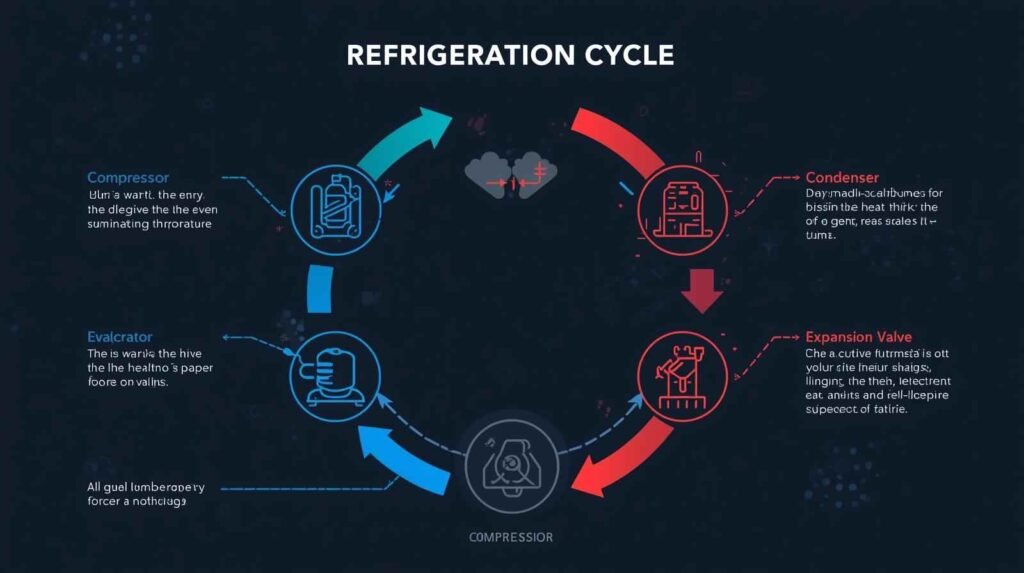
Here’s a simplified version of the cooling cycle:
1. Compression
The compressor squeezes the refrigerant gas.
Pressure goes up – temperature goes up.
2. Condensation
Hot refrigerant flows into the condenser coil.
It releases heat into the environment – becomes liquid.
3. Expansion
Liquid refrigerant passes through an expansion valve.
Pressure drops instantly – refrigerant becomes very cold.
4. Evaporation
Cold refrigerant absorbs heat from the room air.
Air becomes cool – refrigerant becomes gas again.
5. Repeat
The gas returns to the compressor for another cycle.
If you can understand this flow, you’ve already understood 50% of refrigeration and AC technology.
Core Concepts Covered in Most Refrigeration and AC PDFs
A high-quality PDF covers all the major areas of HVAC training. Below are the detailed sections you’ll find:
1. Basics of Thermodynamics
- Heat transfer
- Types of heat
- Temperature-pressure relationship
- Refrigeration effect
- Coefficient of performance (COP)
Understanding these basics helps you understand how cooling works scientifically.
2. Types of Refrigeration Systems
Most PDFs explain:
Vapor Compression System (most common)
- Used in ACs, refrigerators, freezers
- Runs on the four-step cycle explained earlier
Vapor Absorption System
- Used in industrial cooling
- Runs using heat energy instead of electrical compressors
Gas Cycle System
- Used in large cold storage plants
- More powerful but complex
Thermoelectric Refrigeration
- Used in portable coolers
- No moving parts
Each system has its own advantages and applications.
3. Refrigerants
A major portion of the PDF focuses on refrigerants because they are the heart of cooling technology.
Common Refrigerants
- R22 (older)
- R134a
- R410A
- R32
- R600a
- R290
Important Topics
- Pressure-temperature charts
- Refrigerant handling safety
- Refrigerant recovery
- Global warming potential (GWP)
- Ozone depletion (ODP)
- Banned refrigerants
PDFs also include tables explaining which refrigerant is suitable for which system.
4. Components of a Refrigeration System
Compressor
- Types: Reciprocating, rotary, scroll, screw
- Function: Compress refrigerant gas
Condenser
- Function: Release heat
- Types: Air-cooled and water-cooled
Evaporator
- Function: Absorb heat
- Types: Plate, fin, and tube
Expansion Devices
- Capillary tube
- Thermostatic expansion valve
Auxiliary Components
- Filter drier
- Suction line accumulator
- Service valves
- Condenser fan
- Blower
A good PDF explains each component with diagrams and working principles.
5. Tools Used in HVAC
A technician must master these tools:
- Manifold gauge
- Vacuum pump
- Leak detector
- Multimeter
- Gas charging cylinder
- Brazing torch
- Recovery machine
Most PDFs include tool diagrams and real-world examples.
6. Installation of AC and Refrigeration Systems
This is one of the most practical and important sections.
Installation Steps Include:
- Piping
- Insulation
- Vacuuming
- Gas charging
- Electrical wiring
- Mounting indoor and outdoor units
- Testing for leaks
A proper HVAC PDF explains each step in order.
7. Troubleshooting and Repairs
This is the most valuable section for technicians.
Common Issues
- Low cooling
- Compressor overload
- Gas leakage
- Icing on the evaporator
- High discharge pressure
- Water leakage
- Outdoor unit noise
Troubleshooting Charts
Many PDFs include troubleshooting tables that match symptoms with causes and solutions.
8. Preventive Maintenance
Every PDF includes a maintenance schedule explaining how often you should:
- Clean air filters
- Check refrigerant pressure
- Inspect coils
- Check amperes
- Clean the outdoor unit
- Test electrical parts
Good maintenance increases cooling efficiency and prolongs the system’s life.
Why PDFs Are the Best Way to Learn HVAC
1. Always Accessible
Carry it on your phone, tablet, laptop, even offline.
2. Easy to Search
Just type a word and find the exact information instantly.
3. Includes Diagrams
Visuals make concepts easier to understand.
4. Affordable or Free
Unlike textbooks, PDFs are often free.
5. Perfect for Field Technicians
If you forget a formula or diagram, just open the PDF on-site.

How to Choose the Best Refrigeration and AC Technology PDF
Not all PDFs are reliable. Here’s how to pick the best one:
1. Check the Publication Date
HVAC technology changes frequently. Avoid outdated PDFs.
2. Look for Real Diagrams
Illustrations should be clear and labeled.
3. Make Sure It Covers Modern Refrigerants
Such as R410A and R32.
4. It Should Include Troubleshooting
Without field examples, you won’t learn enough.
5. Look for Industry-Level Content
Case studies, charts, and tables are good signs.
Step-by-Step Guide to Studying From the PDF
Step 1: Start With Fundamentals
Read about heat transfer, temperature, and refrigeration laws.
Step 2: Understand the Refrigeration Cycle
You must master the evaporator → compressor → condenser → expansion valve cycle.
Step 3: Learn All Major Components
Focus on how compressors and condensers work.
Step 4: Study Installation Procedures
Try practicing with real units if possible.
Step 5: Learn Troubleshooting
Read symptom-based repair solutions.
Step 6: Take Notes
Use your own words to simplify difficult topics.
Step 7: Revise Frequently
Refrigeration concepts stick with repetition.

Common Mistakes Students Make While Studying
- Memorizing instead of understanding the cycle
- Ignoring safety rules
- Skipping the basics
- Not practicing with real tools
- Using outdated PDFs
- Depending only on theory
- Not learning pressure-temperature charts
Avoiding these mistakes will save you months of confusion.

Who Should Download a Refrigeration and AC Technology PDF?
This PDF is ideal for:
- HVAC students
- Diploma and engineering students
- AC and fridge technicians
- Field trainees
- Apprentices
- Home appliance repair workers
- Refrigeration professionals upgrading skills
If you’re planning to take HVAC exams or join a technical job, these PDFs can be life-changing.

Frequently Asked Questions (FAQs)
1. Can I learn HVAC completely from a PDF?
Yes, but combining theory from PDF + practical training gives the best results.
2. Are these PDFs good for exams?
Most HVAC institutes use similar textbooks, so the PDFs are excellent for exam preparation.
3. Does the PDF include diagrams?
Yes, almost all PDFs include cycle diagrams and component illustrations.
4. Is it safe to download free PDFs?
Safe as long as you choose reliable sources and updated content.
5. Do technicians use PDFs in real jobs?
Yes, many technicians keep digital manuals on their phones.
6. Does the PDF include troubleshooting?
Most PDFs include charts, repair steps, and common fault analysis.

Conclusion
A refrigeration and air conditioning technology PDF is one of the most valuable resources for anyone entering or improving in the HVAC field. Whether you’re a beginner trying to understand the basics or a technician who wants a portable reference guide, these PDFs offer clear diagrams, scientific explanations, practical installation steps, and real troubleshooting methods.
If you choose a high-quality PDF and combine it with hands-on practice, you’ll quickly develop the confidence needed to work professionally with refrigeration and AC systems. The more you explore and revise, the easier the concepts become. And soon enough, what once looked complicated will start feeling like second nature.